I dabble in several forms of art and crafts rather than specialize in one.
I am always trying to learn new techniques, new styles, new mediums.
But what I am drawn to in all forms, is memory crafts.
I appreciate art that incorporates photographs, or trinkets, or clothing from a loved one.
When art celebrates the life of another, or one's past, or illustrates a recollection...that to me holds more meaning than something more esoteric.
My love of both memory crafts and folk art explains why I adore memory jugs.
Too, there's a whimsical quality that just makes me smile.
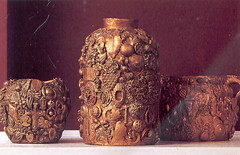
(click on image to enlarge)
From the book,
By Hand: 25 Beautiful Objects to Make in the American Folk Art Tradition, 2001
Folk Art is defined as everyday household items that were decorated by common folk who were untrained in art.
Memory jugs were popular in Victorian times.
Some people believe the craft was not only a hobby for women, but originated from African mourning vessels--a ritual slaves brought with them to the United States. History
here.
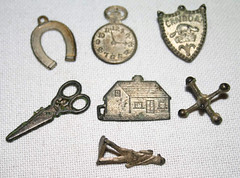
The jugs were ceramicware first covered in some sort of putty, then completely embedded in mementos--buttons, charms, trinkets, shards of china, seashells, pieces of jewelry, and all forms of personal paraphernalia.
These were memory-laden mosaics...three dimensional scrapbooks.
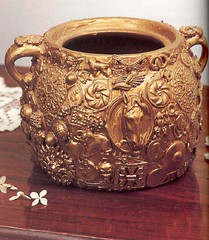
The jugs were not always painted one color like the examples I have pictured here.
This jug is
"built on a molasses jug, it is covered with an extraordinary assemblage including old buttons, an onyx mourning cross, shells, marbles, keys, a belt buckle, broach, stones, English coins, bottles, ceramic people, metallic objects,screws, chains, jewelry, a wishbone, and more. It is topped with a glass finial. It has a pencil eraser holder with a date of 1886 on it. The three coins are all Victorian."It is pictured on
this antiques site.

In essence, these are time capsules.
"
In a time when more and more of our everyday objects are mass produced, these very personal pieces hold great intrigue: they might have been intended as memorials or grave markers, or as a way of honoring family or friend, but whatever the purpose, these fascinating pieces link past to present as poignant narratives. Each of these vessels is encrusted with favorite bits that are too interesting to throw away but are too personal to reveal their meaning. What tale can be told by a vessel encrusted with a pipe, a toy deer, miniature china dishes, a glass doll, beads, walnuts, and upholstery tacks? Did it honor the memory of a dead relative, celebrate the living, or simply make use of attractive found objects? Could it be that making memory ware was a common handicraft of the day, with no sentiments attached?"(
source)
Today, of course, present day jugs are also considered a form of recycling.
But I like the more personal approach--to make a work of art that also creates a memory, a way to salvage bits of your childhood that would have been tossed aside.
I have a frame, for example, that I covered in trinkets from childhood.
I'll have to find it in storage and post it later.
But I always thought that would be a fun way to commemorate a year in the life of your child, and see how the trinkets changed every year.
You know, the McDonalds characters in the Happy Meals, the tokens from Chuck E Cheese, or the jewelry from Disneyland.
I think it's a craft worth knowing about and trying--worthwhile in so many ways.
Labels: history, Inspiration from books and mags, memory craft